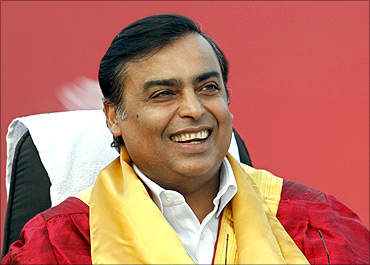
Payments banks will mainly deal in remittance services and accept deposits of up to Rs 1 lakh.
The incumbents Bharti Airtel and Vodafone Idea recorded adjusted gross revenue of Rs 10,701.5 crore and Rs 9,808.92 crore, respectively, during the quarter.

Billionaire Mukesh Ambani on Friday backed the proposed data privacy and cryptocurrency bills, saying India is putting in place the most forward-looking policies and regulations. Ambani, who has been a votary of Indians owning and controlling their own data and the nation drafting strict rules around how digital information is stored and shared, said nations have the right to build and protect strategic digital infrastructure. Stating that data is the 'new oil', he said every citizen's right to privacy has to be safeguarded. "India is putting in place the most forward-looking policies and regulations," he said at the Infinity Forum, hosted by International Financial Services Centres Authority (IFSCA).

While most others have not been able to replicate the WeChat model successfully, experts expect Jio to be able to score on its 300 million plus new mobile phone users.

The depreciation in the yuan has led to a decline in all emerging market currencies

Foreign currency loans raised by Indian companies nosedived to $210 million in the September quarter (Q2), 93.3 per cent less than the year-ago period when five firms raised $3.1 billion. The Q2 amount is the lowest since December 2003 quarter when India Inc raised $191 million. Companies cited volatility in the currency markets, sharp rise in interest rates in the United States, and fund availability in India as the main reasons behind the sharp fall.

The company will invest $747 mn to increase production from D1, D3 and MA fields.

The combined net sales of 42 listed construction and capital goods companies that have declared their third-quarter results so far were down 2.3 per cent year-on-year in Q3FY21 while core operating profit was up just 4.9 per cent YoY during the quarter.

At its current stock price, RIL now has 8.4 per cent weight in the Sensex against Infosys' 8.8 per cent.

After a sharp sell-off in the past two months, overseas investors were once again seen turning bullish on Indian equities. FIIs bought shares worth Rs 63.5 billion in the past five sessions, their highest weekly investment tally in many months.

The decline was led by index heavyweight Reliance Industries along with ITC and HDFC.

The road ahead for the markets in the short term will depend on external factors rather than domestic developments.

Banks do extensive investigation before declaring an account fraud; they owe it to us as they deal with our money. Why would they try to fix an innocent borrower? asks Tamal Bandyopadhyay.
Given the fragmented nature of the domestic cable TV market and the need for last-mile connectivity, RIL, said sources, would have to do more to achieve its target of reaching 20 million homes and 15 million business establishments with its broadband services across 1,600 towns in the next few years.

US e-commerce giant Amazon has written to the independent directors of Future Retail Limited (FRL), including Gagan Singh, Ravindra Dhariwal and Jacob Mathew, and its audit committee, providing data and alleging that there have been significant financial irregularities to the prejudice of public shareholders, banks, creditors, and third-party suppliers. Amazon has said this warrants a thorough and independent examination of all relevant facts and related-party transactions, including of past financial years, by an independent agency. Separately, Amazon has written to Securities and Exchange Board of India Chairman Ajay Tyagi, seeking the withdrawal of the regulator's conditional approval granted to FRL related to the merger deal between the Future group and Reliance.

Petrol and diesel are among the 90-plus commodities that have been approved by the government for derivatives trading

'There is definitely a skill war, or a talent war going on.'

Benchmark indices plunge 4.7% in the first full week of 2016.

The Hinduja Group, Mukesh Ambani, Murugappa, and the Adani groups were the other gainers in the Modi regime, while Naveen Jindal and Sun Pharma groups saw the most erosion in their m-cap in the last five years, reports Krishna Kant.

Asking the government to tweak FDI norms in multi-brand segment, retailers said sourcing rules must be made similar to that of single brand while demanding foreign firms be allowed to put only 50 per cent of first tranche of investment in back-end infrastructure.

Riding on a stock market boom since 2009, India Inc's chief executives have been able to salvage a lot of lost pride in their second innings.

Analysts remain confident RIL's refining and petrochemical segment will continue to support growth.

If the deal is indeed being considered, this will be the first time that Ambani will be putting his money in a print media venture since he and his younger brother, Anil Ambani, split businesses to form their own groups

Over 700,000 new investor accounts have been opened so far in FY15.

In January, Visa's chief executive officer, Al Kelly, said during an earnings call that "there's been a burst of the balloon in valuations in the fintech world". Noting that the trend of lower valuations "is a helpful characteristic of the current environment", he added: "We will look for capabilities and management teams that will bring more value to Visa than we can bring ourselves." Data from KPMG's Pulse of Fintech H2'22 shows that global fintech investment - via mergers and acquisitions (M&As), private equity (PE) and venture capital (VC) firms - at $164.1 billion in 2022, was down 31 per cent over the year before. Indian fintechs held up better during this timeframe, attracting $6 billion, or a fall of 24 per cent.

Reliance Retail follows Future Group in online foray

The 1,967 MW plant has not been operating since August because of stoppage of natural gas supplies from domestic fields.
In a circular dated May 20, Sebi had directed the listed companies to evaluate the impact of Covid-19 on their capital and financial resources, profitability, liquidity position, assets, and ability to service debt. Instead, companies have spoken about the number of plants, warehouses and distribution centres that have resumed operations; work-from-home and safety measures undertaken for employees; and the labour shortage they are facing.

There is polarisation among sectors with IT and healthcare receiving the lion's share of FPI money in the past two quarters.

As with TCS, most companies put their money in mutual funds, corporate bonds and bank deposits, which are losing their appeal versus government bonds in terms of both returns and safety.
The buyback, if successful, will surpass RIL's 2012 share repurchase of Rs 10,400 cr

Meanwhile, retail jewellery sales in India have declined by 50 per cent since gold price started its uptrend nearly two weeks. Buyers deferred their fresh purchase amid expectations of a correction in gold prices from the current high level.
Declaring that the plans will come at less than one-tenth of global rates, Ambani said Jio Fiber plans will be priced between Rs 700 to Rs 10,000 per month "to suit every budget".

Your nearest grocery shop might soon become a one-stop shop for depositing and withdrawing money.

To save promoters from 10% levy, 70 firms call board meetings on interim pay.

Gender diversity at the top can improve financial returns.

Bandhan Bank is the first bank to be launched in eastern India post Independence.

The current valuation is 38 per cent higher than the 10-year average of 22x and over 50 per cent higher than the 20-year average of around 20x.

In an interview with Business Standard, Mazumdar-Shaw spells out her plans for the institution over coming years.

Market cap of government companies has remained unchanged in the past 8 years.
